
This was second time in a month that the TMC supremo had a telephonic interaction with the agitating farmers.

The incident comes close on the heels of a Sikh preacher, Sant Ram Singh, allegedly committing suicide near the Singhu border last week as he was "unable to bear the pain of the farmers".

The locals demanded that farmers vacate the Singhu border protest site as they had "insulted" the national flag during their tractor parade on Republic Day.
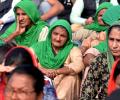
Farmer leaders said they were making arrangements for the women coming from different parts of Punjab. Tents are being put up, a separate langar is being planned, and extra temporary toilets are being arranged, they added.

Delhi Police have arrested three men from Punjab for allegedly painting pro-Khalistan and anti-BRICS slogans near the Singhu border. The arrests were made at the behest of designated terrorist Gurpatwant Singh Pannun, chief of the banned Sikhs for Justice (SFJ). One of the accused, Preetpal, previously arrested for similar activities, is suspected to be SFJ's operational head in India and is being investigated for foreign funding and links to terror operatives.

Punjab footballer Tony Sandhu and Kabaddi player Mangi Bagga from Punjab's Shahkot started the initiative to help protesters with accommodation at the Singhu border. The makeshift arrangement is currently being used by approximately 2,000 people.

The Supreme Court on Monday refused to entertain a plea filed by residents of Sonipat seeking opening of the roads connecting Delhi and Haryana at Singhu border here, which have been blocked by farmers protesting against three agri laws and asked the petitioners to approach the High Court.
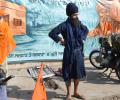
It was business as usual for agitating farmers at Singhu border on Wednesday as some were busy with langars while others listened to speeches of their leaders even as talks of the tractor rally that witnessed vandalism and violence a day before filled the air.

Protesting farmers, who have been holding their fort at the Singhu border for over 20 days, are keeping monotony and boredom at bay by adding new books to their reading list -- day after day.
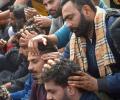
'These small efforts by the youngsters to help aged people like us will go a long way in strengthening our fight against the centre'

A 45-year-old farmer from Punjab, who was a part of the protest against the Centre's farm laws, allegedly hanged himself from a tree near the Singhu border, the police said on Wednesday.
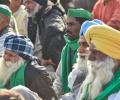
The sewadars, which also include a woman, sit on the ground and urge people to offer their 'jodas' (shoes) while they wait in front of their makeshift counter, on the Haryana side of the Singhu border, close to a tent where farmer leaders speak vociferously against the new farm laws, reiterating demands for repealing them.
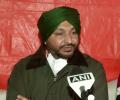
The Ludhiana MP's vehicle was also damaged in the attack at the Guru Tegh Bahadur Ji Memorial where he had gone with Congress' Amritsar MP Gurjeet Singh Aujla and party MLA Kulbir Singh Zira to attend the event.

Delhi Police is making extensive security arrangements for a massive protest called by the Cockroach Janta Party (CJP) on October 10, urging personnel to exercise restraint. The protest demands the Chief Election Commissioner's resignation. Authorities have denied permission, deployed thousands of central forces, ordered liquor shops closed, and proposed metro station closures and border vigilance.

The Supreme Court has stressed the importance of law enforcement agencies exercising restraint during protests, advocating for the pacification and counselling of youngsters, even if some engage in stone-pelting, as it agreed to hear a plea regarding accountability for protest organisers.

Punjabi superstar Diljit Dosanjh has publicly distanced himself from the ongoing protests by the Cockroach Janata Party (CJP) at Jantar Mantar, which are focused on alleged exam irregularities and the NEET paper-leak controversy. Dosanjh reiterated his identity as an artist, not a politician, despite his past support for the farmers' protest and recent appeals to enter politics.

'If elections are held with honesty you will see their defeat.'

Delhi Police have arrested two men for allegedly defrauding a tour operator of Rs 1 lakh using fake currency notes under the guise of a currency exchange scheme.

Recent protests by CJP supporters attempting to march towards Parliament in Delhi highlight a recurring pattern of public demonstrations in the capital over the past 15 years. The article details several significant protests, including the 2021 farmers' tractor rally, the 2011 Anna Hazare movement, the 2012 Nirbhaya protests, anti-CAA demonstrations, and the 2023 wrestlers' protest, all of which involved attempts to reach central Delhi's high-security zones to press demands.

After over a year, the Singhu border, which was the epicentre of the farmers' agitation, now bears a deserted look with the last batch of demonstrators leaving for their home states on Monday.
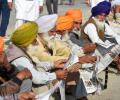
India's capital -- New Delhi -- is witnessing farmers from Punjab and Haryana sitting in at the Singhu and Tikri border points for the past five days, braving water cannons, tear gas and the biting cold. Their reason to protest - the Centre's new farm laws. Here's what it looks like.

On Sunday, the city police removed two huge cement barriers for those commuters who walk towards Delhi using a small passage at the Singhu and Tikri borders.

Authorities in New Delhi intensified security arrangements on Tuesday to stop the farmers' march from entering Delhi as the Singhu and Tikri borders were shut while the Red Fort complex was closed temporarily after peasants on their way to the national capital clashed with the police at the Shambhu border between Haryana and Punjab.

The protesting farmers huddled in small groups to discuss the repercussions of the killing. They also maintained a distance from the journalists who went to Singhu border to cover the incident.

The commuters moving between Delhi and Haryana were either stuck up for hours on the closed borders or walked on foot to reach their respective destinations.

"We are strengthening our communication and other infrastructure to continue the agitation for a long period," said Deep Khatri associated with managing logistics at the Singhu Border protest site.

A group of 101 farmers will march to Delhi on Friday from the Shambhu border protest site, farmer leader Sarwan Singh Pandher has said. The march will begin at 1 p.m. and the group will face heavy police and security presence. The farmers are demanding a legal guarantee for minimum support price of crops, a farm debt waiver, pension for farmers and farm labourers, no hike in electricity tariff, withdrawal of police cases and "justice" for the victims of the 2021 Lakhimpur Kheri violence. The farmers have been camping at the Shambhu and Khanauri border points between Punjab and Haryana since February 13 after their march to Delhi was stopped by security forces.

The farmer leaders insist that the crowd is merely shifting from one spot to another to mobilise more people to join the movement.

Haryana Police lobbed tear gas shells at farmers from Punjab at Shambhu border between the two states as thousands of protesters stayed put there on Wednesday, the second day of their 'Delhi Chalo' march.

Clashes broke out at multiple places and Delhi's borders resembled a virtual battle zone with restless crowds of farmers, mostly from Punjab and Haryana, milling around and a sea of police personnel keeping them at bay.

Farmers have taken down their settlements and have vacated the borders around Delhi, which were their protesting sites for the last one year.

Police said they will not allow the farmers protesting against the Centre's new farm laws to enter Delhi if they reach the borders of the national capital.
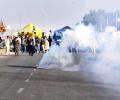
Police used water cannons and tear gas to disperse the farmers who broke barricades in some places in Haryana.

Those gathered at the Tikri border continued to hold ground as wellA decision on whether they would head to the designated protest site is expected soon.
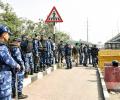
In view of the farmers' protest and march to Parliament, the Delhi police started preparations to check the advancing farmers' march beforehand, an officer said.
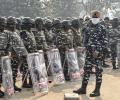
The heightened security measures and restrictions have been brought into place after violence on Republic Day that left 394 policemen injured and one protester dead.

Iron rods have been hooked between two rows of cement barriers on a flank of the main highway at the Singhu border to further restrict the movement of protesters, agitating against the new farm laws.

Standing by his cycle, the 36-year-old from Punjab Moga's district said he could have taken a bus or a train to Delhi, but that could mean his family would have to go hungry.
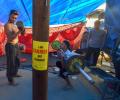
Twenty days on, life has settled into a routine for protesting farmers who are devising ways to crack the code of living through an agitation with no immediate end in sight.

"Protests happen at Ramlila ground, then why should we go to Nirankari Bhawan, a private facility? We will stay put here today," Bharatiya Kisan Union spokesperson Rakesh Tikait said.
